I write a lot about Google. They're an interesting phenomena whose true agenda and nature is constantly fluctuating between good, bad, evil, righteous, and various other complex moral states. Sometimes, one word sums it all up, and fits so well that you wonder why you hadn't thought of this earlier. That word is Chutzpah. From Wikipedia (or "The Ultimate and Omniscient Source of Universal Knowledge and Stuff"):
In Hebrew, chutzpah is used indignantly, to describe someone who has over-stepped the boundaries of accepted behavior with no shame. But in Yiddish and English, chutzpah has developed ambivalent and even positive connotations. Chutzpah can be used to express admiration for non-conformist but gutsy audacity. Leo Rosten in The Joys of Yiddish defines chutzpah as "gall, brazen nerve, effrontery, incredible 'guts,' presumption plus arrogance such as no other word and no other language can do justice to." In this sense, chutzpah expresses both strong disapproval and a grudging admiration.
Or, for the reading impaired:
On that note, I would like to announce that Google has deemed me worthy of giving me a developer preview of their new collaborative content platform called Google Wave. It's really hard to put the idea into words and give it proper identification, but in their own words: Google Wave is what email would look like if it was invented today. Meaning, Email was modeled off the snail mail system, in which you wrote a letter, and the recipient received that letter and now owned it. Wave does away with that silly notion and innovates the way we look at cloud collaboration. Put simply, when you write a message to somebody, he can see you typing the message at the same time as you. Both sender and recipient own the content, and both edit it along the relationships formed by normal mail contact information.
After I got my invite (and danced the dance of joy and happiness), I opened up IE (no choice; it was a work laptop) and I opened up Google Wave. I was then hit with a splash screen that blew my face off (very messy). It was the most chutzpah I've seen on the Interwebs in a long time, and it may signal the start of a new era in the browser wars.
IE is not supported by Google Wave.
Ok, read that again.
Are you still with me?
I'm not.
You do realize how unbelievably mind-shattering this is, right? You don't just release a product that isn't supported under IE (Just to be clear - it does run in IE if you install the Google Chrome Frame Activex control that may or may not break IE. But the point still holds. IE out of the box does not work with Wave). It's like releasing a car that doesn't drive on interstates. Or a music player that doesn't play mp3 files. It doesn't make sense, it's audacious, it's arrogant, it's brazen, it's non-conforming, and it's straight up Chutzpah.
It's also the stuff that revolutions are made of.
The age of IE (Internet Exploder, Internet Exploiter, take your pick) is coming to a close. Years of chipping away by browsers like Opera, Chrome, and most importantly and successfully, Mozilla Firefox, are finally bringing the industry to a point where things like can happen. Google Wave is going to change the way we collaborate in the Interwebs (many are calling it the harbinger of Web 3.0), and IE has been left out of the party. It's a blatant act of war, and one that's been a long time coming.
This may all be sensationalist thinking, as the restriction may be a quirk of the developer preview, but hey, the sensationalist way is typically the fun way, and I will indulge.
Don't worry, as soon as I get some more time with Wave, I'll let you know not if it rocks my world, but how much it rocks my world.
Wi-fi in airports has always been a diabolical scam that frustrates people to no end. Well, there is an end. It's murder. I haven't gotten to that end yet, but I've gotten close. Now Google, the Great Provider Of Free Stuff and also The Ones Who Punched Me In The Face, are going to give it for free this holiday season. You sit down at your gate, turn on your computer, and you have Internet connectivity. They even offer a "donate" option for those in the holoday spirit. Yipee.
Now, for the paranoia.
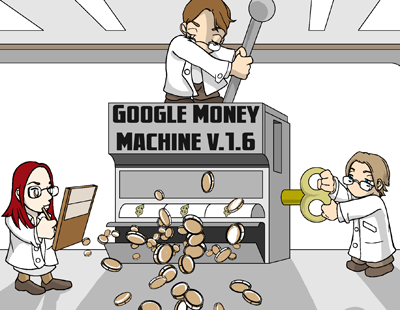
What does Google stand to gain by this? All they are doing is paying companies like Boingo for their service so that they can give it to the user for free. Let's say you pay 10 bucks for 20 minutes of Internet. Google will not make that much off of you in 20 minutes. So they will likely lose cash on this.
Why is it only for the holiday season? If they wanted entry into the airport wifi market, they would set something up a little more permanent. I guarantee you that they are not doing this out of pure holiday jubilation.
Let's start with this: Google is not in the business of service delivery. They are in the business of data. And they have the best business model ever. Everything they give you for free, you really are giving them your data. This data is more valuable then you'll ever know, because it isn't your data that's valuable, rather the same data coming from millions of people. You may get access to all that data, but in the end, it belongs to them. And it makes them very powerful.
So this is what I think: Google doesn't want to make you happy. It wants data on travellers. It wants to know where you browse, what you search for, how long you stay on sites, if you're working or goofing off, and if it is worth it for them to make permanent deals with wi-fi providers to grant them that data. If this little data experiment shows that data mining air travellers is profitable, you'll likely see google search as a default search option in the Boingo browser home page. You'll get an option to download google toolbar when you install the Boingo client, and your data will belong to them.
Another option would be that Google is considering acquiring Boingo (or others) and actually rolling out a free wifi service based on ads, but that doesn't seem likely given the insane profit margins Boingo likely has.
This is something to keep track of, and it should not be dismissed as philanthropy.
Edit: I'm probably wrong about my theory. Here's an article that gives a much better motive to the madness. The Article
I found myself at lunch with a co-worker engaging in a heated debate (read: reality flame war) about the current state of politics and government. As usual, nobody won (except for me) and we all went about our geeky ways, thankfully without any bloodshed. A point was raised that made me think (even more so than the thinking I do all day). The other guy was saying that the corporations run the government, that we, as voters, don't really have power, and various other silly things like the CIA killed JFK and that the government knew about 9/11 and let it happen. He was right about one thing. As voters, we have close to no influence on national politics. At first, this bothered me. Then it didn't. And now I'll tell you why.
The Internet changed the way we see ourselves relative to the world. It brought the world closer to us. Anything we ever wanted to know, Wikipedia knew it. Any news story was on the Interwebs within minutes, and had 100 comments in just a few minutes more. Since the important national and global issues became so easily accessible and immediate, we only cared about those stories because the local stuff seemed banal compared to presidential scandals and health care reform.
The problem started when we drew a logical connection between our ability to voice our opinion and our ability to control the vast quantities of information we were fed. If we could know all this information so easily, it must also be easy to control all that. Knowing this, the news media highlighted story after story of individual Interwebs users changing the face of government. Tools like Facebook and Twitter became key buzzwords in the news for their ability to empower the anonymous individual.
Once the power of the individual became an entitlement, we started treating our system like a true democracy, instead of the representative republic that it really is. We assumed that since we could post our status on Facebook and people would listen, that our congressmen would do the same. We assumed that since we now had a voice that our government really wanted to listen.
So, it becomes a shock when we find out that the big businesses and bigger pocketbooks actually run the country, not the people. All of a sudden, the corporation is seen as a usurper of our right to change and our right to influence the powers that be. That makes them evil.
People don't realize that it's always been this way, and it always will be this way. Greed and power will always be the main element of politics, and philanthropy will almost always be a power tool. When faced with listening to the people and protecting a revenue stream/job security, the voter almost always loses. Politics never rewards altruism and dedication to country, because that doesn't pay the bills. What you see in the media is not what really goes on behind the scenes, and the big players are always more important than the small fries.
But it isn't all cynicism and gloom. There's a whole level of politics and policy that the average Joe has power over and shouldn't in any way ignore.
The media has portrayed the national political scene as a somehow accessible environment that a little hope and a little spunk can change. And that's when we started ignoring our local governments.
Local government is where the real battles are fought. Local governments are made up of community leaders who understand that for a city council vote, every vote does count. Every person that they do good by will tell other people about it, and get votes. City officials live in the city and therefore care about your community as much as you do. Yes, money and greed are still the impetus, but here it's on a level that the layperson can get into and affect. In the hullabaloo over health care, my personal state government passed two laws directly affecting taxes. Why was this ignored? If anything, I should have wanted to know about that more than healthcare news because I could have tried to affect the state legislature. I could have talked to my district's representative and he may have actually listened. I could have gotten involved on a personal level and I would have been much more satisfied than engaging in flame wars about the government's knowledge of 9/11.
If you really care about politics outside of the desire to argue with people, then you absolutely can. Join some society's, lead some community projects, meet people, talk to people, and make yourself known in the local scene. Write some editorials, attend city council meetings, and before you know it, you'll be "in politics".
Unfortunately, the Internet has eroded our sense of local community. We all live in a country, but we also live in our community, and the local community has issues that directly affect the way you live that you actually have control over.
So I humbly ask the denizens of the Interwebs: If you all really do know everything (which you allegedly do), then stop wasting your breath on the forum trolls. No matter how vehemently you oppose gay marriage, and no matter how big you can make your words defending that stance, you will not change anything. If you think your opinions should matter to somebody, and to legislative policy, get off my Interwebs. We don't do stuff like that here.
Finishing with my original point, people have to stop thinking that our federal government cares what you think. Let’s get this straight: you are one in a few hundred million. They don’t care about you. Getting all upset at government putting businesses over individuals is futile, because it’s a fact you’re going to have to deal with. On behalf of the Interwebs, I apologize for making you think you matter. You don’t, and your Twitter followers won’t change that. In order to regain our individual importance, we need to get back in to local politics, and make a scene. If we do that, I think we can change the face of national politics, slowly but surely. And to bring this to a technology standpoint, local politics needs some serious Interwebs help. If you can run a decent viral marketing campaign, you can win a local election. I don’t think local campaigns have leveraged the power of digital communities yet, and now would be a great time to take advantage of that.
I know this wasn’t a tech post really, but thank you for sticking with me. I needed to get it off my chest. And I have no friends.
I've been watching Jericho, a TV show cancelled in 2007 after a short one season but was critically acclaimed as "good TV". I agree. It is good TV.
However, it suffers from the same malady that plagues every TV show released in the past decade. They have a complete disregard for reality when it comes to anything computer related.
Now, don't get me wrong. I understand that this is TV, and that every body of knowledge has been desecrated in some way or form by the imaginations of writers, especially the laws of physics (and the laws of going to the bathroom. Nobody ever needs to use the toilet on TV. It drives me nuts). But some things are so easy to get right, yet writers always get them wrong. Almost like they're doing it on purpose, just to make me angry (a perfectly plausible reason).
Some background: Jericho is about a nuclear attack on the US in which 23 major cities are vaporized in one short moment. The show chronicles the story of the inhabitants of the smalll town of Jericho, KS, and their quest to survive and adjust to post-apocolyptic America.
So, the scene I'm about to show you transpires after eletricity is temporarily restored to the town, and the population realizes that the Internet doesn't work. As a girl names Sklar attemps to check her email, Allison (whose father may or may not be a Super Duper Secret Agent Man) tries to offer some tech tips.
Failure Ensues.
Ok, let's break this down.
Skylar is fake-typing furiously at a screen that says "You aren't connected to stuff". Protip: If you're going to fake-type, at least make it so that it looks like you're doing something. When in the history of Internet Explorer have you been able to magically connect to the Internet by typing in magical hacker codes that don't even show up on the screen that you're typing on?! At least pull up a command prompt! This is just a symptom of another pet IT peeve of mine in TV shows:
Nobody ever uses a mouse.
Now, I know that in the geek realms that I reside in and call home, keyboard shortcuts are key to productivity, and if you ever have to use a mouse to accomplish anything, you're doing something wrong. What you're doing with your mouse could be done in a fraction of the time with shortcuts, and you are therefore inferior. However, that's not what most of the world. Most teenage mall rats trying to check their email after the apocolypse will not know the various wonderful shortcuts the "Windows" key makes possible, let alone know magical hacker codes that connect you to the post-apocolyptic Interwebs.
So, along comes Allison, angsty teenager turned networking guru, with some helpful tips. After witnessing Skylar utterly fail at fake-typing, Allison reccomends that she type in the staright IP address.
As Allison would say, "Oh, no you di'n't".
Here's some Basic knowledge easily looked up in Wikipedia. When you type in a web address, this nifty little thing called a DNS server translates your web address into an IP address. This was implemented so that you we don't have to memorize 12 digits every time we wanted to go to a website. Very simple. So, Allison thinks that maybe only the DNS servers were wiped out in the nuclear apocolypse, but the rest of the country's network infrastucture is still intact. And I know exactly where this misconception came from. The writer probably saw his company IT guy connect to a company server using its IP address (sometimes it's just simpler to troubleshoot that way, expecially when your local DNS is wonky), and thought "Wow, a magical hacker code to connect to Internet! Even when all the wires in major cities were wiped out in a nuclear apocolypse! This must be someting all the cool trendy teens know how to do. I'll put it in my show and impress the techies." And just to continue the theme here, let's assume that the Internet magically survived. It's really a huge testament and praise to the people in charge of the Internet that viewers assume that after the nuclear annihilation of 23 cities, you'll be able to login to Facebook the day after at your local Starbucks Wi-Fi hotspot without a hitch in service. News Flash: The Internet isn't some transcendent being that resides in our physical realm through the magic and wonder of computer geek fake-typing. It's a bunch of computers dustributed accross major universities and research centers that communicate with each others and the powers that be have duubed "The Internet".
And just when you thought it couldn't get worse, Allison goes ahead and types in an IP address. The address she types is....
827.750.304.001.
Now, before I go and explain how this isn't even remotely close to anything even resembling a valid IP address, let me point out to ridiculosity (that word rocks, shut up) of the whole scenario once again. Let's say Skylar was tring to check Hotmail. Quick, what's the IP address for Hotmail? Ya, didn't think so. Neither does anybody else. And one other slight criticism: You need to press the Enter button when finished with your super hacker fake-typing. "Enter" is the universal keystroke of "Go do all that stuff." Internet Explore requires you to press the "Enter" key when finished typing in your address in the address. Go ahead, see what happens when you type in an address up there and not press the "Enter" key. Hint: Nothing happens.
Now, let me tell you what an IP address is. The Creators Of The Internet (Capitalized for Effect) decided that the world would need a standard system in binary that would store the unique addresses of Internet sites all over the world. So they took 32 bits of binary units (4 bytes, if you're counting), and split up the Internet. The amount of possibilities come to 4,294,967,296 diffferent unique addresses, give or take none. They split it up (in a little trick called subnetting, which I won't explain now) so that instead of referring to yahoo.com as site #3,518,979,381 (the value of 11010001101111110101110100110101, the IP address of yahoo.com), they split all those billions of IP addresses into 4 bytes. So that big binary number up there becomes 1101000.11011111.0111010.0110101. In decimal, that's 209.191.93.53. If you made all the numbers in those 32 bits "1", it would be 255.255.255.255. That's the highest possible IP address in the current IPv4 way of doing things.
That may have been a little complicated, but still. 5 seconds of Google love is all it takes to figure that 827.750.304.001 is an incredibly dumb number to use. An it's not just that all the numbers are not even close to the range. That last number, 001, is just stupid. The whole point of writingit out the way we do is because it is a real number representation of binary. 001 is not a real number. It's hard to believe that nobody on the set at the time pointed this out to someone. It's a pointless lack of simple research.
And it only gets better. Allison says, "But the Internet was designed by the military (SPOILER ALERT: It wasn't really, they just started it) to withstand a nuclear blast (except for the DNS servers)!" I won't even bother to explain how asinine that tidbit of wisdom is, being that "The Internet" isn't a "thing" that can be "destroyed" by bombs. This, followed by Skylar's shining moment of ingenious intellect and insight, "So, why can't I check my email?? (while continuing to quickly fake-type)" should be enough to make any self-respecting nerd start foaming at the mouth.
Alas, things only only go downhill from there. All of a sudden, everyone's IE browser is covered with a Public Service Warning that tells everyone that everything is going to be OK. Now, this makes perfect sense being that nobody had access to the Internet. This is the only plausible way something like this could maybe happen:
- Some super-powerful Internet server is still functioning somewhere that has access to all the DNS servers and has the ability to force your browser to route every request to a single server with that message, without having the user refresh the page or actually try to click on something (SPOILER ALERT: This can't happen).
- It apparently is able to grant Internet Access to everyone that didn't have access to it a moment ago (SPOILER ALERT: This is impossible as well).
- All the physical wiring needs to be intact, along with the routing functionality of all ISPs providing access to the DNS servers. (SPOILER ALERT: What part of Apocolyptic Nuclear Annihilation didn't the writers understand?)
- It would have to bypass spyware, malware and virus checkers (SPOILER ALERT: It won't. You'll get a warning that you have a trojan or something and that would be the end of it).
Of course, the proper response to this is more furious fake-typing, until Skylar finally gives up and secretly admits her failure to implement her obviously l33t haxzor skilz and dies a little inside.
This is just one of many tech stupidities that pervade TV shows and movies these days, and I don't mean to say everything needs to be exactly accurate. That would make things unbelievably boring (If Jack Bauer forgot his password to his Windows Active directory account, he would have to contact the helpdesk to reset that. I don't care how badass he is. IT owns him). But please, please do some basic research. I know you can't always follow the laws of physics, and I'm cool with that, but some things are too easy to get wrong.
It was with trepidation and anxiety that I pressed the Install button on the Windows 7 setup screen. It's futuristic blue hues and user-friendly language did nothing to assuage the mounting tension I felt as I remembered the last time I installed a new OS. I Vista-ed my computer last time (sort of like "bricked my computer" but worse). That was when I lost my faith in computing humanity. After suffering through the despotic ruler that was Windows Vista, the Seventh coming of Windows has arrived, and I have received it and it's legal license key.
To be specific, I have a Win7 Professional 64-bit OS running on my system, and now I want to talk to you about it.
I was impressed from the get-go. When I first logged in, I expected to put aside 3 hours of my valuable time to clear the OS of bloatware like Norton's ubiquitous deal with Satan 30-day trial and ebay web links. Instead, all I got was the Recycle Bin on the desktop. I did a double take. Did that really just happen? Did Microsoft really just provide me withe clean OS? Something horrible must have happened. It must be a virus. Or Something. This just felt awkward. Like if your parents actually did buy you a car for your birthday. What are you supposed to say? Thank you? Words can't contain the gratitude I felt a that moment.
After that, everything seemed sorta the same. Yes, yes, yes, the taskbar is different. But nothing like "OMG,OMG!!! THE TASKBAR IS THE BEST THING SINCE SLICED BREAD!!! IT WILL CHANGE THE WAY WE PUT TASKS IN OUR BARS!!!! YAAAAAAYYYYYYY!!" It's definitely a slick improvement, but it's nothing revolutionary. All the changes I've seen thus far from a user experience standpoint have been small things that make stuff easier to find and do. Which is great. But it hasn't wowed me in any big way yet.
A lot of people are saying that Windows 7 is like a big service pack to Vista. I would use a different analogy. I would say it is what Windows 98 was to Windows 95. From a user experience standpoint, nothing was all that different. The foundations of the desktop environment are still there. It's the stuff under the hood that made 98 a much more stable, and therefore longer lived, operating system. I haven't had enough time to get into the nitty gritty yet, but I'll let you know when I do. Maybe I'll host a launch party!
Smile moments: Powershell 2.0 included, speedy wake-up from standby, trippy backgrounds, small improvements to explorer interface, the library system.
Frown moments: Powershell was surprisingly slow, actually liked the vista look better, still not so speedy startup, not sure if homegroups will really take off, nobody came to my launch party.
Net Neutrality is a buzzword these days. For those who live in huts (or use dial-up), Net Neutrality is the most recent left wing attempt at overhauling an established private infrastructure towards a more government-centric paradigm. That infrastructure would be the Interwebs.
The FCC is trying to pass legislation that will regulate ISPs and their bandwidth allocation. The FCC believes everybody has a right to the information superhighway (I haven't used that name since the 90's and it makes me feel old) and that ISPs have no right to restrict access to it. The timing is obviously tactical. Recently, many ISPs, and specifically Comcast, have been heavily criticized by the right wing for throttling bandwidth for customers engaging in frequent Peer to Peer transfers (like BitTorrent). The thought is that the people using the most p2p bandwidth are most likely using it for illegal purposes and therefore can be slowed down. This comes after an already controversial move by Comcast and others to "plant" illegal copies of movies just to track who was downloading (and almost always inadvertently) and uploading the movie. Now that the right wing is all up in arms against the ISP, the left has decided it to be the perfect time to stage their coup on the Interwebs.
I can go on and on about how wrong it is to socialism-ize (that is now a word) the Interwebs, but I hope I don't need to tell you that. I have a different point to make. All I have to say is: Be careful who you mess with.
The Interwebs is owned by the geeks. It is their realm, their kingdom, and their Dungeons & Dragons (4th edition) dungeon. They live in the Internet, and the Internet lives through them. With the World Wide Web spread out before their superhumanly speedy fingers, the Geek will always find a way to get what he wants in his own homeland. Be it a movie, a program, a game, or top-secret classified government documents, the Geek will find it, and he will get he wants without anybody knowing he was there. Like a ninja. Bespectacled and zit-ridden in RL (Real Life), the Geek becomes Superman at the keyboard. If you tell a Geek that your system is impossible to break into, he will reply "Give me five minutes". If you tell him that what he's doing is illegal, he'll tell you "I already won that flame war. It is illegal no longer". If you tell him his lvl85 paladin looks like a pansy....he will cry.
If the government really tried to take away the Interwebs from the Geeks, the Geeks would revolt. The revolution and cyber-uprising that will ensue when policies of artificial scarcity are enforced on the Interwebs would put the geeks in charge of the new digital economy. This is because no matter how much regulation the government tries to put on bandwidth, Geeks will find a way to circumvent the regulations. They always havem and they always will. This will just leave the layperson with an overpriced and slow broadband connection for no good reason.
This is all based on historical precedent. Every time the government (usually manifested in the RIAA) tried to regulate data flow, the geeks came out on top. Securing the mp3 format led to the P2P movement, proliferating mp3 saturation by many orders of magnitude. When Napster was shut down, the BitTorrent method of file sharing was created, effectively protecting everyone involved, and further growing the market for music and software pirating. Also, understand that the copyright breaking is not usually done for profit. It can be quite spiteful. When Electronic Arts released it's blockbuster PC gaming masterpiece, Spore, it used an archaic version of DRM (Digital Rights Management) that infuriated the gaming community. In a startling testament to the spitefulness of the geek community, Spore quickly broke records upon release as being the most pirated game in PC gaming history. And it wasn't even that good.
You see, Geeks can be pushed around in RL, but if you try to invade our digital kingdom, we quickly become vindictive and violent (and alliterative). If the government really tries to restrict bandwidth, there will be war. And we both know who will come out victorious.
“My young son asked me what happens after we die. I told him we get buried under a bunch of dirt and worms eat our bodies. I guess I should have told him the truth - that most of us go to Hell and burn eternally - but I didn't want to upset him.”




 Posts
Posts

