2.18.2010

Olympic IT

It just goes to show how big of a Technologist I really am.

Whenever there's a big public event on television, like the olympics, the first thing that I think about is how IT is executed at these huge venues. What's different about the big events is the lack of permanence. At my place of business, the IT infrastructure is meant to stick around for quite a while. The cabling and organization is set up with that in mind. But events like the Olympics are a different beast altogether. All the effort, time, and money invested in IT infrastructure for the Olympic games is only for two weeks of service. After that, it all goes away. It amazes me how fast the IT pros working on these venues do their jobs so quickly and effectively.

Luckily, Cnet grabbed an interview with the head of IT at the Vancouver Winter Olympics. It's short, but he makes some very good points.


My favorite line of the whole video is when he says that the goal is to be as bored as possible. I guess that's the goal of any IT shop, do keep anomalies and downtime to an absolute minimum. However, I think it's a little different at a short-term, high-intensity effort like the Olympics. IT from a corporate perspective is all about growth, about not being stagnant in a dynamic and ever-advancing industry. If you're bored, you're probably falling behind, and not leveraging your IT department in a way that drives maximum profit. The Olympics is not about profit margins (at least from an IT perspective). The goal is to get in, get out, and make sure the event is properly connected to the world without a hitch. The objective is concrete, simple, and all-encompassing.

So, boredom works when your objective is clear. Us corporate types, while we may think that's the goal of IT, know and understand that the real winners in our industry are the ones that make sure they're keeping busy, but not because you can't keep up. You keep busy because you're always looking ahead to the next innovation and tool that will drive profit in your company. It's important to understand that difference.

In my world, it's the difference between being on the podium, and hurtling down a mountain, skis flying every which way, hoping to reach the bottom without serious injury.

Maybe I should start working for the Olympics.  

2.12.2010

Changing The Rules Of War


(Over the next few posts, I'll be discussing issues brought up in the spectacular PBS Frontline episode called "Digital Nation", which discusses current issues in the digital invasion of our societies).

The world of the soldier is a world of risk management. You shoot, you get shot at. You go to war, you may not come back. These have been the unwritten rules of war for many thousands of years, and it has shaped the civilizations of the world and the social constructs and hierarchies that we live and relate to every day. the danger of war creates heroes and villains, and it's unique ability to take a staggering amount of life and limb makes it a force worth reckoning, and a serious mover of people and history.

This is why those who play video games like Call of Duty and Medal of Honor laugh at the idea that it's desensitizing them to war and violence. Gamers aren't stupid, and they realize that they are just pressing buttons in a virtual world, as much as the game designers want them to think otherwise. They understand that the actions they do in the game have no effect in the real world.

When you look inside the Air Force bunker in the desert outside of Las Vegas, NV, you could swear that that a bunch of gamers were getting together for some fun and games in a military setting. It's a bunch of guys, sitting around big screens and keyboards, talking military lingo, and controlling the action on the screen with joysticks. If it wasn't for the military attire, this would look no different than a small gaming convention. As the pilots shout commands back and forth using all kinds of military lingo and abbreviations, the action on-screen heats up. These pilots are playing some kind of simulation that very effectively simulates a precision air strike on targets they would be fighting overseas. No better training exists than this. The action looks eerily real, and the pilots are glued to the screens as if they were actually there, fully aware of their superiors standing behind them, evaluating and pondering every move and every strike.

The simulated target is a bogey on a motorcycle. He's going to meet his terrorist friends in an abondoned warehouse outside the city limits, and the pilots are tracking him to find out where this building is, and then take out the whole meeting with a well-placed bomb. The pilots cycle through all the typical reconnaissance technologies, tracking this guy so closely, you can almost make out his facial features. He takes a few detours. He stops to get a bite to eat and plays with some children in the street. The simulation wants to make this guy act like a real person would, to heighten the believability of the scenario. Finally, the target approaches the building and enters. A few moments later, the pilots are given the order to fire. The air-to-ground hellfire missile slams into the building, practically evaporating it.

Mission Accomplished. The pilots fly back to base, and land. In the real world, in Las Vegas, the pilots take off their headsets, shut off the computers, and go home to their families, safe and sound.

It may have looked like a training mission, but that that building really was destroyed. There was a real plane out there, firing real rockets, and killing real people. These pilots are piloting the newest and one of the deadliest weapons in our Army's arsenal. They are the pilots of the MQ-1B Predator Drones, the unmanned aerial vehicle (UAV) that is becoming ever so popular in Iraq as the air-strike tool of choice. It's changing the entire landscape of human conflict.

These soldiers are controlling an object thousands of miles away. It may as well be a video game. When they fire a missile, they don't feel it like a real pilot does. When they fly at ridiculous speeds, they don't feel G-forces. They don't wear oxygen masks, and they don't wear seatbelts. If it wasn't for military policy, they could come to work in khaki pants and a T-shirt. If they get shot at, there is only money to lose. If they get shot down, they still go back to their family at the end of the day. And of course, when they kill someone on screen,  that person is really dead.

It's scary, really. When you're that detached from the reality of combat, and yet your actions control the battlefield, it changes the way you think. There's a reason why the military requires military garb in this bunker. If the pilots weren't reminded constantly that they are fighting a real war, this may as well be the most realistic video game ever. When you're on the battlefield, you see the consequences of your actions, up close and personal. In a video game, you can afford to be reckless; your life isn't on the line.

It isn't very good for mental health. When you're being shot at, it isn't hard to fire back. When you're on the other side of the world, and you kill dozens of people with a keystroke, it messes with your head. When you go home to your family every night after leveling city blocks and killing countless bad guys behind the veil of the computer monitor, the emotional gravity of the situation starts to get under your skin, and many of these pilots need therapy for PTSD and other war-related mental health maladies.

on a less personal level, like I mentioned before, this is changing the entire battlefield of human conflict. When wars are fought from behind a computer screen, well behind your own borders, the dynamics of combat will never be the same. War has always been fought as a desperate struggle over human life. If you make a tactical decision, there is always the risk of getting shot at. The Predator drones are taking away the risk of death, and replacing it with the risk of monetary loss.

Many find this controversial. Studies go back and forth trying to determine if the drone pilots take more risks, and endanger the lives of more civilians, than say, an F-15 pilot who is constantly risking his own life doing the same work. I can see both sides of the coin. On one side, the freedom to make tactical decisions without risking life and limb should enable pilots to make more calculated strikes, and striking in ways that will decrease collateral damage. On the other side, the detachment from the actual field of battle could make the pilots detached from the reality and the consequences of what they do, causing them to focus on the objective more than the facts of life and death on the ground. In other words, you never worried about destroying neighborhoods when playing Call of Duty, because it wasn't real, and you knew that the game put more emphasis on completing the mission than keeping collateral damage to a minimum.

The Predator Drone is something out of a Sci-Fi movie. It is, quite literally, a cyborg army. War will be changed forever when robots are dying in place of humans. The only question is, will this change be good for us, or will it usher in a new, bloodier, age of conflict; an age where battles are won by the biggest wallet, where civilians are ignored because the pilots can't see them die. Or will it actually decrease violence in the world? When fighting a war only results in monetary loss, what's the point?

War is hell, true. But is will soon be just a virtual hell. And the world won't ever be the same.

1.29.2010

Why Can't I Be A Car Mechanic?


I hate cars so much right now.

I learned about basic scheduled maintenance the hard way when my heat started smelling like anti-freeze and my windows became coated with a greasy condensation that no amount of defrosting could vanquish, so I pulled into my local Midas to get it over with. Fingers crossed, I put my trust in the good people at Midas and hoped and prayed that my car was OK.

Two hours later I get a bill for $2800. Apparently, my car is in an imminent state of screwed. Here's all that was wrong with it:

- Heater Core is leaking (thus the smell and fog)
- Radiator is leaking oil
- Brakes are about to be metal-on-metal
- Timing Belt is cracked
- Cam Shaft Position Sensor is malfunctioning

Most people are lucky to know what half of those things are and what they do. But, the friendly and slightly country fellow at Midas warned me that I better get this stuff done lest I die in a flaming conflagration of car parts and gore. Alas, I could not afford to pay all that, so I began my quest for a second opinion.

Enter Brian. Brian is about as country as it gets, and he's an honest guy. You may not understand half the words that are coming out of his mouth, but you can be sure he'll give you a deal, and be honest about what really needs to be done. So I bring my car over to him, and he takes a look-see. Not only did he work minor miracles with the old Suzuki, he managed to fix the heater core leak with two tablespoons of black pepper. Yes, you read that right. Apparently, you can put pepper in your anti-freeze and it will go through your coolant system fixing leaks. It does this because of the inherent property of pepper to expand and solidify when dried. Or something like that. Either way, the point is that he could have charged me 800 bucks for that alone, and he ended up fixing it with pepper, and charging me with labor. He pointed out to me some other things I needed to look at, but assured me that it could wait a while longer, and come back when I could afford the various fixes.

He was a lifesaver, and I saved thousands of dollars by getting a second opinion from him. But that doesn't make me feel any better about the whole situation. You see, IT mechanics are just like car mechanics. We prey on the laypeople who are computer illiterate and take our every word as divine nerdy truth. When we tell people they need a new hard drive, they don't even ask why. They just pony up the cash. They need their computers so badly that they pay for anything, and don't stop to get a second opinion or second-guess the knowledge of the mechanic. It's a powerful feeling being respected for your opinion, and abusing that power is  simply part of the status quo best practices of the IT industry. When I deal with car trouble, it's very uncomfortable being on the other side of that playing field. I'm the one that gives expert advice, figures stuff out, and finds deals on things. I'm not the guy who is at the complete mercy of a high-school educated car mechanic.

Every time I feel that pressure of not knowing, I get angry at myself for not being educated about cars and their innards. I mean, cars are really no different than computers. The job consists of troubleshooting a machine made up of various interchangeable and necessary modules, and deciding whether or not to fix said modules or replace them. The difference is mainly in the tools (and the amount of grime). Just like I learned 50% of my IT skillz assembling and disassembling an old computer, the same could be said about cars. I should be able to get an old junk car, pop the hood, break stuff, and fix it again. I see no reason not to be perfectly capable of changing a tire, refilling oil, draining coolant, finding leaks, replacing cables and hoses, etc.  If I can assemble a working motherboard from disparate parts, I can replace a battery. It kills me that I'm making myself pay hundreds or thousands of dollars to do a job that's probably simpler and sometimes even more rewarding than what I already do all day.

This is something I will learn how to do. I can't accept paying so much money for things that I should know how to do, and would most likely even enjoy doing, myself. Over the past few days, I have learned a lot about cars, about engines and coolant in particular, and how maintenance on your car is just as important as keeping your Anti-virus and Windows Updates current; about how flushing your coolant is as important as a defrag and disk cleanup; about how replacing your brake pads is as important as replacing your hard drive every few years; about how putting pepper in your anti-freeze is kind of like.... well, nothing really. That was just friggin' nuts.

So, here's to my pledge to learn how to fix basic car trouble this year. No more getting screwed by Midas for this technologist (I'm not a geek).

P.S. Extra points of you laughed at the picture.

1.13.2010

This Is Why I Love XKCD

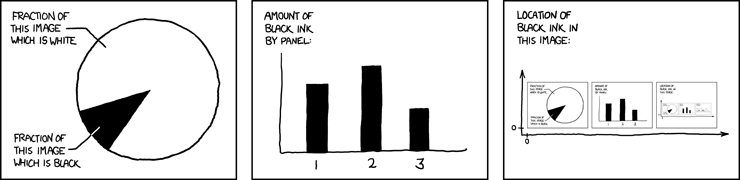
Before you embark on this journey of spontaneous cranial combustion, just remember that Randall Munroe, author of xkcd, was an engineer at NASA. Here we go (please click on it to see a bigger version. You're going to need detail for this):

Now, before you click your back button and scoff at the pointlessness of this strip, I urge you to read it a few times, and really think about it. Specifically, think about actually drawing the strip.

I'll give you a minute.

OK, this strip is an example of what we call self-referential recursion. Let's start with the self-referencing part.

Take this sentence: "This sentence has nine characters in it". True or false?

False, obviously. But now change the number so that the statement is true. It isn't easy. I don't think it's actually possible, and this is where the self-referencing part comes in. Read this rule slowly and carefully (lest you mind explode):

The amount of characters actually in the sentence is dependent on the amount of characters in the number of characters there are in the sentence.

Here's how it works. With no number in the sentence ("This sentence has characters in it"), it has twenty-nine characters. But once you put "twenty-nine" in the sentence, you've changed the amount of characters in the sentence, and it is false. The only way to make this true is to change the rest of the sentence around. Even then, it isn't a simple task.

Now, look at the first panel of the comic strip and see it with new understanding. And just in case you're a skeptic, the anally nerdy xkcd forum members have already proven the numbers to be accurate.

OK, got that? Now, off to the second panel. It's very similar in awesome-tude until you realize what's in store in the 3rd panel. Then you realize how much of a crazed genius this guy actually is. It's basically just a bar graph of the amount of black ink per panel, relative to the other panels. We already understand that this is quite complicated to determine, because it's self-referential and all three bars of the graph depend on how much black ink is in the graph itself. I'll let you mull over that one for a bit before we head into the recursion part of this little brain genocide of a webcomic.

OK, on to the third panel. On first glance, it seems a little pointless. He simply drew the strip again, and drew some lines outlining the location of the ink on the page. But now that we understand the point of the last two panels, the absurdity of this one isn't hard to spot. First of all, remember that it's self-referencing. In order for the second panel to be true, the amount of black in the entire comic has to be already known before any of the panels are actually drawn, and the amount of black in the third panel is just a smaller proportion of the already known amount of black in the strip. Are you numb yet?

Because this only gets better.

Most people would simply stop there and bow in nerdy worship of the great and holy Randall, but they miss the final blow to your brain. There's still the recursion to deal with. Let's do this.

Put simply: The entirety of the third panel is true. 


In order to understand this, we need to go back to the first panel. The exact language was: The amount of black in the image. Not in the panel. In the entire strip. It's hard enough to understand when you realize how hard self-referencing calculation can be (which we just did), but the third panel just brings this into a whole new level.

The third panel is infinitely recursive. It contains images of itself, shrinking forever until you reach a number called 1/infinity (a fraction infinitely close to zero). The amount of black ink in each recursive image also shrinks, making a infinite summation. This means that you keep adding a smaller and smaller number to the previous number. For example, if the recursive term is 1/2, then the infinite summation of 1 over 1/2 is : 1 + 1/2 + 1/4 + 1/8 + 1/16 + 1/32 + 1/64 + 1/128 + .... etc. It ends up infinitely close to 2. This what we call the limit of the function f(x)=1/2y as x goes to infinity.

By the way, if you're still keeping up, we're doing calculus now. Be proud.

So, in order for that value in the pie slice of black to be true, it would have to be the limit of an infinite summation of the black ink in each recursion of the strip. So the first panel has to take into account the rate at which the third panel shrinks the strip and thus calculating the limit as the summation approaches infinity, and each "first panel" in the third strip also has to reflect the total proportion of black in the entire image, even as the values of black in each addition gets closer and closer to 1/infinity.

Also, notice that the first panel never mentions the actual amount of black. Only the amount of black in proportion to the amount of white. When it shrinks, the proportions hold true even though it talks about that black in the entire image, because it is a proportion and not a value. The second panel deals with the actual amount of black in each panel. Since it is a graphical representation and not numerical, and it references the black levels in each panel, it holds true in every recursion of the third panel. Thus, the third panel is always true, even as the images get smaller.

So, let's review:

- The strip accurately calculates (in black) the amount of black in the strip.
- This is called a self-referencing calculation.
- The total amount of black in the strip had to have been calculated and known before the strip was even created (i.e. you can't do this with trial and error), which is insanely insane (and redundant).
- Due to the nature of the third panel, the amount of black in the entire strip (which was known before the strip was made) is actually a value that represents the limit of an infinite summation of increasingly smaller values of black in every recursion, and thus, the slices of the pie chart also represent limits of infinite summations. (Read that a few times. Trust me, it makes sense)
- Every recursion of the third panel is true, because of the proportional nature of pie charts, and that graphical bar graphs can be shrunk proportionally and still be accurate.
- Oh, and like I said, analysis has already been done on the black levels in the strip, and it's eerily accurate.

Yes, this is what Randall Munroe finds funny.

And this is why I love xkcd.

1.07.2010

Airport Security and Network Security


Once again, airport security is thrust into the limelight as it suffers an almost catastrophic failure to prevent the presence of explosives on passenger planes. A crackdown is about to ensue on many international flights, customers are in an uproar as ticket prices continue to reflect the security woes, and the lines only get longer. It can only make you feel that something isn't working.

Airport security is in many ways similar to network security. In network security, you have millions upon millions upon millions of data packets wanting access to your network, You know that 99.999% of those packets are just regular old communications going about their regular business, trying not to bother anybody, but needing to arrive on time. You can't rigorously check all the packets, because your network will break. But you have to have some layer of auditing, or else that .001% of data will wreak catastrophic damage on your systems. At this point, network security is all about setting rules that recognize good data and let it through without needless security checks. It's also about recognizing bad data based on signature files provided by Anti-virus products, as well as recognizing behaviors and traits exhibited by typically malignant data traffic. This is a very organic process, changing and growing every day, as dynamic as any human security system, if only on a different scale. Networks have to adapt on a daily basis as the threat environment changes and new technologies create greater and easier exploited vulnerabilities in even the most revered and venerable products on the market.

Security admins rely on religious tracking of log files and constantly educating themselves in the latest security  best practices to properly secure their systems. They know that the battles can be won, but the war is eternal. Unless you are constantly changing and adapting, you will lose the security battle. Every time. Security Admins understand that while performance needs to to take a hit sometimes to ensure good security, there's a fine line between acceptable slowdown and a broken system. Toeing that line is the challenge that ever admin faces, and knowing where to cross that line can mean the difference between uptime and financial ruin.

Also, there is no such thing as a random search of network traffic. You set up rules that flag suspicious traffic, and you can be running a low-level, unobtrusive scan of everything else as it passes through your routers and switches.

This could be a perfect model of how airport security should work. Of the hundreds of thousands of passengers flying on a given day, maybe one has malicious intent towards passengers. Maybe. This is because any attempt at mass destruction and crime on an enclosed airplane at 30,000 ft. is suicidal, and only the most deranged and extreme attempt it. Another little fact: At least 90% of extremist acts of violence done on planes are committed by dark, middle-eastern, Muslim young men. This is simply fact. There is no disputing this. They are being trained to do this overseas, as evidenced by the recent Christmas attack. When you have a clear as water pattern that makes sense, why would you try a random search?

If the logic is undeniable (try to deny it, it isn't really possible), then why are we so bad at making a working system that everyone is happy with?

The answer is little invention called "civil rights." I put in quotations because its usage deserves it. Somehow, it has become a civil right to be assumed innocent, even at the expense of lives. The argument becomes "You can't search me, that's an invasion of privacy! I have rights, you know!" When face with the cold logic of statistics and numbers, this argument is a moot point. If we know that people are pltting to blow up planes, and we know that in even the most conservative estimates, that person will be a dark, Arab, muslim, man, then why are we even having this discussion? And that's just the first fallacy of the argument. It is extremely selfish to think that your "privacy" (if you think that the TSA not knowing what goes on planes is privacy, then you're an idiot for other reasons) should endanger hundreds of lives. This isn't a personal attack on you, this is a precaution to try and stop criminals from killing you. Knowing you're innocent won't convince the TSA of anything. If you try to play the race card and tell me not to assume that just because you're Arab, you're a terrorist, I will play the moron card and tell you that i don't assume you are a terrorist. I assume that a terrorist will be someone who looks a lot like you. Therefore, I need to search you. I don't think you're guilty, but a guilty person would most likely be Arab. There's a big difference. In one, I am a racist. In the other, I am simply making logical and sound decisions on who search based on empirical evidence. It's not offensive, it's smart.

Obviously, we can't go around just searching Arabs. That leaves out the 5 or so percent of the population who would also commit horrible airplane crimes. We account for that 5 percent by doing a low-level, unobtrusive search on everybody. It would ideally be computer-run, would happen in seconds, and you wouldn't have to take your shoes off. I also don't think we need to be strip-searching every Arab. Aside from racial profiling, there is behavioral profiling. If we're not going to search every Arab, than we need to at least focus our behavioral monitoring on that demographic. It's proven to be a successful system in countries like Israel, where terrorism is an every-day threat, and there's no reason why it can't be enforced here in America. It's a lot cheaper than randomly scanning bags in state-of-the-art detection equipment, and it's about as unobtrusive as you can get.

I understand that there's a line somewhere that we're trying not to cross, but the numbers don't lie. We have start thinking like every other security environment, and be logical about our search criteria. Political Correctness is only an excuse until you have impaired an industry so much that half its airlines close their doors  or declare bankruptcy.

The Department of Homeland Security is of the opinion that their responsibility is not to catch terrorists, but  to prevent them doing whatever it is they do. If that means catching them at home or at work, then they've completed their job. That is what they'll tell you if you ask them how many terrorists they've caught at airports. They'll tell you that catching a bomber red-handed is not considered a success, and that's why you don't ever see it happen. They're usually caught long before that. Well, if that's the case, that terrorists aren't supposed to be caught at airports, then why are you spending so much time and money making airports look like border crossings? If you're so confident that you'll catch the bad guys before they sit on a plane, why don't you act like it?

IT security knows very well that giving data the "civil rights" and "privacy" that they deserve "as an American citizen" will end up in a compromised system. They also understand that you can't check all packets indiscriminately. It's about time that the TSA learns from their errors and starts treating security with the logic and know-how it necessitates.

12.28.2009

Avatar, A Look At The Confused State Of The Technologist


Avatar is a wonder of modern technology. We've all heard about, some have seen it, and we all agree that James Cameron worked bloody hard to make this movie the most advanced visual experience to grace the silver screen since the first frame of superficial animation. In ten years, Cameron has reinvented the idea of 3D cinema, the art of Computer Graphics, and the role of the real in the unreal. He spearheaded the development of audio/visual technology in ways nobody had imagined previously, and he had the cojones to spend more money on a movie than anybody else in history. Though it is entertainment, it is also a ballsy display of modern innovation and technological dominance that sets the bar higher for everyone else.

This is horribly ironic, this being the most anti-technology, environmentalist, tree-hugging, machines-are-evil, meditative-nature-religion, save-the-rainforest, movie anyone could possible dream of. It's funny that the movie that most exhibits the power of the non-limits of human innovation is its own worst enemy. I mean, look at the numbers:

- Rendering the movie: 8 gigabytes/sec, 24 hours a day, over a period of months.
- Storing the movie: Each minute of film comes to around 18 GB.
- Processing Power: A feat of parallel processing, 34 racks of 32 quad-core processors each (34 x 32 x 4 = 4352 processors!). All running at 8Gb/sec for 24 hours/day.

That's pretty intense for a movie with an environmentalist message, don't you think?

Then I read a New York Times Op-Ed by Neal Stephenson. Here's the link. It talks about Star Wars, and the subtle war between geeking out and vegging out. It's a very interesting article, but it poses a very bleak scenario for the technologists of the world (He even uses that word! Yes!). He writes that the Jedi Knights were the geeks of the Star Wars universe. They were the ones that everyone depended on to make things work, to know all the arcane knowledge there is to know. They were the ones called in to solve the hard problems, and they were well-versed in many aspects of technology, from flying warships to building light sabers. If you read a lot of the back stories of Star Wars, the various novels and off-shoots of the main cinema canon, you realize that the Jedi were hated by most simply because they were very good at what they did, they were masters of their world, and they were necessary for the world to function properly. This resentment is perfectly modeled through the writing of the last three episodes (episodes I, II, and III). The Jedi way is increasingly attributed to meditation and "trusting your feelings" than to the study of warfare and calculus.  Stephenson explains this as the writers writing what the viewers want to see. They want to see the abilities and powers of the Jedi as a product of meditation, something that anybody can do, as opposed to a product of years of training and study.

It's really nice to see on the screen that just by "trusting your feelings" you can deftly pilot a dog-fighting warship into the laser-riddled hellstorm in the beginning of episode III and come out victorious. or that winning a pod race is a simple as flipping some switches and "trusting your instincts".

In reality, technology is hard. Too many "geeks" of the world believe that playing World of Warcraft in weeklong marathons makes you a master of technology. They are falling into the cultural trap that says you don't have to try to be who you want to be. You just have to look and talk like that person and you can become that. You can now be part of the high-tech community simply by using certain Internet memes a lot and by knowing certain movie scripts by heart. There's a reason why the science nerds are all becoming Asian. It's because Americans have stopped caring about the effort it takes to run our world and control its minutiae. Students are flocking to liberal arts majors instead of taking the more challenging route and excelling in something important. Biology is giving way to psychology, physics to journalism, and Computer Science to MIS (I'm guilty of that one). We want all the perks of intellectual dominance, but we are lulled into the dream that simply acting intelligent is a valid substitute for being intelligent.

So, James Cameron bothers me even more now. Seen in this light, the Na'vi in the movie are naturally gifted masters of their environment, able to interface with many complicated aspects of animal and floral life via a "wire" of sorts that can attach to all kinds of things in the wild. For example, banshee riding is made simple through a natural neural connection between banshee and rider that allows the rider to control the animal with thought alone. No training required. They are masters but they never have to try. They just need to "be one with nature" and all of a sudden they are the masters of their world. The humans, on the other hand, have obviously made great leaps and bounds in technology to do what they do on the planet of Pandora. We see snippets of it in the form of the Avatar technology and the military prowess, but we can only imagine what Earth looks like at this point in history. They are the villain in this story. Avatar shows us that progress only leads to destruction and genocide. Only by communing with nature, and by "being one with the wild" can we ever hope to achieve any kind of moral civilization.

Audiences will eat this up. The techies, the ones responsible for running the stuff that keeps us alive, they're the evil ones. The guys that train for years, the ones that are steeped in knowledge and experience, the ones that apply what they have years learning to everyday life, the people who try to make progress, they're the evil ones. If only we didn't have to depend on those people to survive; if we could be more like the Na'vi, not having to work for mastery, then we would do no evil.

Ironic, coming from the guy in Hollywood who is arguably the most steeped in cutting-edge technology and money. I'm not sure what the message is supposed to be regarding all this, but I found the irony....ironic.

12.23.2009

Nerdiest Holiday Humor Ever

Seriously. If you find anything else more scientifically anal, please let me know.

12.21.2009

Google's Endgame


It's almost funny.

Google has released 38 products in the past 70 days.

Most of these won't be seen by all but the most dedicated Googler, but some will change the face of the SEO (Search Engine Optimization) industry forever. And the venerated company doesn't seem to be losing any steam. Anyone paying even slight attention to Google for the past ten years understands that their meteoric rise to world dominance wan't a fluke. It has followed a pretty steep upwards curve and nothing short of full-on catastrophic Google-cide will remove them from their throne upon high.

One of the 38 releases I refer to is a nifty little tool called Real Time Search. It wasn't hyped much, and much like other Google releases, flew under the radar waiting for people to stumble upon it. It's a simple idea, really. When you search for something like Healthcare Reform, a little box appears within your search results that gives real-time updates of news from that subject. "News" includes Twitter updates on the subject, RSS feeds from blogs, as well as Facebook and MySpace feeds about it. This all flows down in the box at a steady pace, updating every few seconds to show the lastest results.

At first glance, this seems pretty cool, but borderline useless.

But then I got a glimpse of the Singularity, otherwise known as Web 3.0.

Web 2.0 is still a buzzword these days. It represents the idea that users should be able to put publicly accessible data into web containers hosted on websites. The most visceral and raw version of Web 2.0 is YouTube. The content is all user-generated, and the website is only as good as the content users dump into it (which means YouTube is pretty atrocious as far as web sites go). This idea took off and became MySpace, followed by Facebook. It became Picasa and Flickr, Blogger and Digg.Web 2.0 changed the way we see the Internet, and is the sole reason the Internet recovered from the .com burst a few years back.

Twitter came and sounded the death knell of Web 2.0. I don't think they meant to do this, but they quickly grew from something resembling a glorified status-update to a quantum leap in the speed of collaborative communication. Twitter provided a near-instantaneous walls-free link to the 140-character thoughts of anonymous users all over the world. The use of the simple hashtag (#) to group subjects and keywords grouped tweets into streams that reflected what people around are thinking about, say, #google, right now. This has no boundaries, no friends to accept, no privacy settings to drill through, and no networks to join. Just pure, raw, text-based flow of collective consciousness. This wasn't Web 3.0, but it was definitely 2.5 at least./ It abstracted the ownership and control of data on the Internet even more than social networking did, and became a media-driving giant faster than anyone could believe.

There's another pattern behind the versioning of the Web, aside from the issues concerning control over content. As the technology behind data communications grows by leaps and bounds, as the connections between nodes become exponentially faster, continuing the ever-popular and ever-insistent trend of Moore's Law, we're getting closer and closer to an ideal form of communication that is instantaneous, and is passive instead of active. We are coming into an era where information is not something you seek out, but something you absorb as it simply appears on your screen the moment it is created.

Let me cut to the chase here, and explain to you how Google's real-time search works. This is an innocuous little feature that works like this: When you search for anything, you can go into the search options to display "updates only". What this will do is provide a continuously updating feed of comments and thoughts from sites like twitter, facebook, and myspace. This all happens in real time. I tried it out. I had a search open for "google" in google. In another window, I had my Twitter account open (@Interwebsruler fololw me!). I "tweeted" (I hate that word, but I guess I should get used to it) "google is awesome!" Almost immediately, my tweet showed up in the google search, with a little "posted 1 sec ago" blurb at the bottom. This is an unbelievable feat of search engine power. And it means that Google has achieved the beginning of a revolution in the way we interface with data.

Remember, the entire paradigm of data in the Internet is changing. Instead of the search for knowledge being an active process, an activity that has the user searching for something that already exists on the Internet somewhere, the tables are turning, and the whole idea of search is switching sides. As soon as information comes into existence, it's already on your screen. It's now a passive experience. The idea of "jacking in" to cyberspace and living in a world of consistently updating data flows is now a reality.

This is what Google is aiming for. Google wants to create an Internet that is ubiquitous and instant, not a repository of information, but a living, breathing, dynamic, world of information that it always alive and always changing. As users, our job is not to find the data, but simply allow the data to find us. When you put content into the Internet, you don't give it a destination. It doesn't travel, really. It just becomes instantly available for anyone that wants access to it. Instead of the Internet being a framework in which data repositories like Facebook and wikipedia can communicate with each other, the Internet will eventually be the container in which all the data is stored. The website will no longer be a place to control and input data. It will simply be a filtering system to direct the persistent flow of data to those who want it.

And guess who is going to control that data container? You guessed it. The Google.

I know that a lot of this probably makes no sense to many people. It doesn't make a whole lot of sense to me either. But I think I've given you a clearer picture of what the Internet will look like once the age of Web 2.0 is left behind for a newer, even more daring, frontier. And I think we all know that Google will be at the forefront of this war over the control of data flow.

The final frontier of Google dominance is where the war with Microsoft begins. You see, an integral part of the control Google wants over the flow of information is the protals through which the data flows. As of now, Microsoft owns that. The browser and the OS that is used to access the Internet is still not under Google's control. This is Google's biggest challenge. Data flow is only as good as the method used to get the data. Google plans on fixing this. They released the Chrome web browser (which is now able to have plugins, much like firefox) last year. They released Android, their Mobile OS, this year. Next year is the release date for Chromium, their PC OS. Seems like they've got their bases covered. They even have a little package called "Google Chrome Frame" which lets you take your IE and emulate Chrome on it.

It's going to be an interesting few years, and I'm just excited to be a part of it.

12.11.2009

Net Neutrality: Real Consequences


The Blogosphere has been throwing around the term "Net Neutrality" for a while now, discussing the theoretical morality and practicality of such an edict, and generally discussing it on a very high level that only the Technologists of the world really care to argue about.

Things are about to get ugly.

Ralph de la Vega, CEO of AT&T Mobility and Consumer Markets, recently spoke at UBS (big investment company) conference in NY, and spoke about the possibility of charging heavy data users more than the average  data user. He specifically pointed to the fact that 3% of AT&T smartphone users are responsible for 40% of total data usage. He went on to describe in which AT&T is devising ways for users to be able to track their data usage in real time, hopefully curbing the data usage behaviors of the super-heavy users.

(As a total aside, that's ridiculous. Do they really expect users to stop using data because they feel bad? They bought unlimited plans; unlimited is what they'll get. To expect them to be socially conscious of their data usage is just bad market research)

Market analysts are seeing this announcement as a threat to users: Rein in data usage, or we'll charge you more for it. There's nothing wrong with doing that, only that you'd lose all of your customers. Your status as an "unlimited" user doesn't alleviate the scarcity of data that ISPs have to deal with. There is a finite number that represents the size of total bandwidth, and simple rules of supply and demand require ISPs to charge for demand when supply is scarce. So, why now? Why is AT&T talking about this now when this has been a problem since phones became smart years ago?

Jared Newman, at PC World, has a great theory. He claims that AT&T is bluffing to try and stave off the Net Neutrality movement. Proponents of NN want to impose rehgulations that make ISP bandwidth allocation equal across all legal uses of data communication. One advantage of this is that Comcast would have to stop throttling bandwidth of heavy peer-to-peer file sharing users. This is the kind of behavior that the people behind NN are displaying as reasons to regulate bandwidth. However, it also means that bandwidth will become even scarcer than it already is.

Right now, AT&T users on video chat in Skype are getting a faster connection speed than users checking their email. This makes obvious sense. Why give users connection speeds they don't need? This is a dynamic and fluid allocation, because it is dependent on what you are currently using. The email checker gets a higher speed when he switches to using video chat and the video chatter gets his bandwidth throttled when he checks his mail. This is how ISPs conserve bandwidth and ultimately save money for the consumer.

Newman thinks AT&T is trying to scare off proponents of NN by threatening to raise rates. And they would have no choice but to raise rates if everyone was forced to have equal bandwidth all the time. It would mean that the amount of bandwidth required by the heavy users would have to be equal to the bandwidth given to the light users. AT&T wants to make something very clear: Do this, and the customer will pay. We'll gladly give out more bandwidth, but bandwidth is much more scarce in the wireless industry than in the wired industry, and someone has to foot the bill. Newman thinks we need to call their bluff, and force them to stop throttling bandwidth. He doesn't think they'll follow through and charge more. I disagree.

People take "unlimited plans" for granted. ISPs market it as a golden ticket to infinite data when in reality your speeds are measured and change constantly so that the illusion of unlimited can be maintained. When you sign up for wired internet, you don't ever get an unlimited plan. It's already assumed that you can use as much data as you like. However, there are very clear brackets of download speeds that cost more or less. The speed you get is the speed you pay for, and that's how things have been working for quite some time. There's no reason why AT&T can't start pursuing a similar model. Putting a data rate cap on low-paying users would be no different than Comcast putting a cap on users in their budget cable Internet plan. People are seeing these threats as "against the consumer" and "typical evil corporation" when in reality they are just planning on doing what the rest of the wired Internet world has been doing for years.

So, while Net Neutrality may cause this to happen, it will end up happening regardless of Net Neutrality laws being passed. Data will always be a scarce resource, becuase no matter how fast you manage to get the data to users, someone will build software that requires the full potential of whatever data rate you can dream up. Net Neutrality will just force wireless providers to make an already scarce resource even scarcer, making users who wouldn't need to pay more for speed spend more money just to support the small-time users who won'n need the bandwidth anyways. This just seems like a big waste to me.

12.08.2009

The Technologist Manifesto


There’s something fundamentally wrong with a group of people that define themselves proudly by a term that is considered derogatory for 95% of cultured civilization. No, I’m not talking about Democrats (Joke. Please don’t unleash the Flames). I’m referring to Geeks.

It makes me cringe to even say it now. Why have we been putting up with this for so long? The fact that we’re really good at what we do has been completely subsumed by the idea that we don’t take showers (we don’t. But that’s not the point). The fact that the world is becoming more dependent on our services every day is completely ignored next to the fact that we can’t talk to members of the opposite gender (we actually can. As long as that person knows their way around a command prompt and can give us the decimal representation of a 6-digit binary number, we could SO have a coherent conversation). The fact that several of the world’s wealthiest people subscribe to our dogmas, and that that the President of the Frikin’ USA demanded that his blackberry be tweaked, by us, for use as the Official Smartphone of the Commander in Chief does nothing to ameliorate our allegedly more important lack of fashion sense.

You see, we have an image problem. When Best Buy unveiled its newest nefarious plan to coerce money from the wallets of innocent consumers, The Geek Squad, they made it very clear that these people couldn’t dress themselves beyond black and white, with a skinny black tie. They made it very clear that these people had no life whatsoever and that they were created simply to hook up all your crap, and drive Beetles while doing it. They wanted people to come in expecting an anti-social college grad that hadn’t showered in at least 2 days, who acted superior and condescending, who spoke incoherently about all things technical, and in the name of all that is unholy, they succeeded.

The point I’m trying to get at here is that we need to find a different name for ourselves. Yes, I know that we like to be non-conformist and identify ourselves with a label that only we think is ‘cool’. But seriously, we aren't in high school anymore (We are in college). We need to grow up and realize that as much as we like being ‘different’ and ‘counter-culture’, we need to get jobs. The world has come a long way in the past 40 or so years making the computer world a necessary part of life, but those who master the science of the geek must come out from under the silicon curtain. We need to free ourselves from our self-imposed showerless incarceration and start wearing clothes that match. We need to break free from the chains of parental dependence and start proving to the world that can apply the same skills we use to kill users kill ninjas troubleshoot PCs to living a life as productive citizens.

Now, I know that this is a lot to ask; Identifying color schemes between all the various necessary clothing objects on my person is a skill set that will haunt me for the rest of my days. However, I propose a small but important step. We need to change our name. I don’t mean translating our current names into Klingon (Google already offers this important service to humanity). We have to do away with the term “Geek”. Maybe if we stop calling ourselves geeks, we wouldn’t follow the negative behaviors associated with the term. If we were called Computerologists, maybe we would take one more shower a week. If we were called Computing Professionals, we would dress a little better. Maybe if we weren’t called “IT guys” but “IT Men” we would have some more self-confidence in casual conversation. Maybe if Desktop support was replaced with Desktop Pwnage Operation, we would get paid a little more.

There are many possible names, some better than others (IT Men sounds like it would be a great name for a gay Internet Café). In all seriousness, I’m leaning towards Technologist (Cham-vaD, loosely translated into Klingon [“for technology”]). I go around calling myself a professional geek, but I would feel a whole lot better about myself if I would go around calling myself a technologist. A company wouldn’t have an IT guy (or Man), but instead have a Resident Technologist. There are probably better names out there on the Interwebs, but that’s the best I can think of right now.

From here on out, I will try to refrain from using the word “geek” to describe my Technologist brethren. The image of the “geek” is one we made for ourselves and we are the only ones that can fix it. We have an image to save, and right now it’s being saved as a low-quality JPEG. Get that lossy **** of a format off my hard drive, take your rightful place in society, and don’t ever wear a brown belt with black shoes.

Note: This is a work in progress. I plan on making revisions and improvements to this as they come to me. I'll keep you posted. Maybe one day somebody will take it seriously.

12.01.2009

Reinstalling the Healthcare OS


The American Healthcare system is broken.

Or, as the geek would say, the OS needs to be reinstalled. If I may coin an analogy here, the American Healthcare system is to Socialized Medicine as Microsoft Windows is to Linux. Now, before you jump down my throat and rip out my innards with your vastly superior Conservative claws, let me elaborate. Linux works. Nobody doubts that. On a small scale, in an ideal environment, where everyone involved knows the system and help is just a Google search away, Linux is the best OS out there. And it’s free. Unfortunately, we don’t live in that world; users break the unbreakable, they know nothing about computers, and they can’t take care of themselves when things go south. Windows isn’t the most stable or cheap OS out there. But it is comfortable, packed with user-friendly features, and if you have a minor problem, it can be solved by most people with basic computer literacy. Unfortunately, there’s a price tag. And it’s not only the money. If you ever have a serious problem in Windows, the back-end infrastructure is so vast and bottomless that even the most grizzled IT pro out there needs help from time to time. There are entire libraries of back-end architecture support tools that less than 1% of the population will ever even look at. Look up WMI on Wikipedia for a great example. Here’s an excerpt from the overview:

In order to unify the management techniques for the sake of simplicity, the DMTF defined CIM to represent real-world manageable entities in a unified way. The CIM object model is an object database model using terms and semantics that are unique to all constructors and software developers. This object model is implemented in a database called the CIM repository.

Based on the CIM model, WMI includes real-world manageable components, available from the DMTF standards with some specific extensions that represent the various Windows components. Moreover, WMI exposes a collection of COM-scriptable objects that allow various applications to take advantage of the management information.

As part of the installation process, most of the Microsoft applications available today (e.g. SQL Server, Exchange Server, Microsoft Office, Internet Explorer, Host Integration Server, Automated Deployment Services) extend the standard CIM object model to add the representation of their manageable entities in the CIM repository. This representation is called a WMI class, and it exposes information through properties and allows the execution of some actions via methods. The access to the manageable entities is made via a software component, called a “provider” which is simply a DLL implementing a COM object written in C/C++. Because a provider is designed to access some specific management information, the CIM repository is also logically divided into several areas called namespaces. Each namespace contains a set of providers with their related classes specific to a management area (i.e. RootDirectoryDAP for Active Directory, RootSNMP for SNMP information or RootMicrosoftIISv2 for Internet Information Services information).

To locate the huge amount of management information available from the CIM repository, WMI comes with a SQL-like language called the WMI Query Language (WQL).

See what I mean?

Windows is shiny and sleek, with an absolutely huge set of tools mostly inaccessible to the average user, and expensive to boot. It puts on a good show; it makes people think they’re being treated to a 5-star hotel when they’re really just staying in a souped up Econo Lodge with free HBO, Continental Breakfast, and a concierge that pretends to care (The Taskbar!!!! It Will Change The World!!!!). No matter how much free food Econo Lodge throws at you, the building is still on the verge of collapsing on you while you sleep. Free HBO doesn’t make up for the cigarette burns in the carpet or the slight stink in your sheets. However, the price of admission isn’t high, you know it when you see it, and you don’t get confused figuring out what to do once you pull into the parking lot.

I believe that’s what our Healthcare system is like right now. The concept is great. The whole triangle of patient-insurance-caregiver is a good model, and it does what it needs to do. However, when it breaks, it breaks hard. The seemingly simple interface of the triangle opens up to be the most complicated geometric object in Euclidian reality, and when something isn’t working, when insurance decides not to follow the triangle and doesn’t reimburse the caregiver, you are left to traverse the insurmountable labyrinth of private insurance to get answers. This leads to inefficient care, inefficient spending, and consumer apathy. The consumer becomes a simple pawn in the complex chess game of coverage, and is forced into premiums and charges that will break the system. This sounds a lot like Vista.

Now, let’s look at Linux. Back to the hotel example, Linux is like a hostel. Yeah, it’s free. But go there alone for the first time without a friend, and you might get raped.

Just sayin’.

There are distributions like Ubuntu that attempt to make the experience user-friendly, but in the end, the terminal will still be the only way to do things properly. If you don’t learn yourself some command-line, you won’t really be using Linux, and your experience will be second-rate at best. There’s an amazing amount of free tools and flexibility in Linux, but unless you know how to get around, or know someone who can teach you, you’re doomed to a bare-bones, barely functional OS, with maybe half of your hardware having the right drivers. The success of Linux is completely dependent on the ability of the user to learn how to get around. Help is out there, but it can be hard to understand and usually depends on your knowledge of other obscure command-line tools. Most users will simply give up and say that they have a working system when in fact they don’t know what they’re missing.

I believe that this is the state of Socialized medicine. Everyone seems to be happy with it, but they don’t know what they’re missing because they don’t bother to try harder. For them, a month wait for a surgery may be awesome, but nobody in America would even consider waiting that long. Sure, there are plenty of people who have learned how to navigate the Socialized medicine system and come out with a great experience, but that won’t be the case for the majority of people. So, does the potential to be a great OS make it a great OS? Does the fact that a healthcare system should work make it a good system?

I know that this analogy is somewhat controversial, as I am impinging on two separate religious flame wars at the same, and I don’t expect everyone to agree with me. This is just a framework with which to understand the questions and the problems. I think I may have some theoretical answers, but I’ll save that for another post. I need to flesh it out a bit more.


P.S. Mac OSX is like the healthcare system of Sweden. They think they’re so special and awesome, but they’re still Sweden. Nobody cares.

Edit: Thanks to the Benjamin at The Daily Harangue for fixing up my graphic. Sorry, I was using MS Paint. I'm old school like that.

11.20.2009

The Pathology of a Viral Video

YouTube is force of nature. It is a law of Physics all to itself, and it is unstoppable. It is an open medium with which people share their thoughts and ideas in the form of badly-produced, low-quality videos. It is free, and it is easy to use. It has become the preferred method of comedic outlet in the digital era, and it created this thing called the Viral Video. The viral video has its roots in the Internet Meme. A meme is something, usually a word or phrase, that has no inherent value or comedy other than the fact that it has been arbitrarily applied all over the Internet to a certain situation. A good example is "fail". Nobody knows the exact source of this meme, but when someone does something stupid, a label of "FAIL" gets applied. If it is utterly stupid, that person gets an "EPIC FAIL". Now, these things only mean what they do because of the amount of people using them, and that's a testament to the power of the Internet, and the vast numbers of people using it.

The Viral Video is the Web 2.0 version of a meme. Take the Rick Roll. A musician by the name of Rick Astley made a music video once. It was horrendous. At some point in time, that video was used in a prank where a seemingly innocuous link on the Interwebs brought you not to your intended destination, but to a Rick Astley music video. Shorty thereafter, the RickRoll was canonized in the Interwebs  lexicon of Funny Things That Only People Who Are On YouTube For At Least 2 Hours A Day Find Funny. Rickrolling became an Internet sensation, and only a select few people actually know who Rick Astley even is. Look it up on Youtube. If you dare.

The example I want to focus on today is viral on a much smaller scale, but it happened so quickly and so decisively,  and it disappeared just as fast, that it's a great example of how Viral Videos do their thing.

So, there's this show that used to be really popular with the angsty teens. It was called 'The OC', and those who remember the fad know how indescribably terrifying the specter of watching that abomination was, and how all your guy friends who started watching were obviously either doing it for their girlfriends, or subtly coming out of the closet.

Well, here's the last scene of the 2nd season.


Got that?

Good.

Now here's Andy Samberg's take on it from SNL.


That's comedy gold, friends.

Now, in a pre-youtube world, that would be the end. We would all have a laugh, and walk away. But nooooooo, this little juicy nibblet of comedy had an appointment with destiny, and it was about to smash in the office door with impunity.

People started doing parodies of the parody. It started innocently enough, with people adding the idea to video game scenes, like this one.


It then got applied to other famous youtube videos. Like this one.


And then, dear readers, things only went downhill. Or, I should say, things threw themselves off a sheer cliff into the neverending abyss of the pop culture comedic hell that is the YouTube population en masse. In rapid fire, here's some of the main offenders.


There's so much more, and a simple Youtube search will uncover startling amounts of these videos, all starting from one finale of a season of the OC. They definitely didn't have this in mind when filming that.

So, here's my favorite. I laughed out loud. At work. Very awkward.


Oh, and I forgot about this one. Very similar to the original SNL version.


pwned by the Astley. If you didn't see that coming from at least a few miles out, you haven't been spending enough time on YouTube.

Some would say you should keep it that way.

11.18.2009

Identity Theft Madness


Identity Theft in The Matrix

There is nothing I hate more than being lied to.

Ok, that's not really true, but using 'hate' in the first sentence really makes the blood boil, doesn't it?

Good. Now that your blood is at a slow simmer, I can explain to you from whence this hatred comes. I was watching the television last night, enjoying the feeling of my brains rotting from the inside out, when a commercial came on that grabbed my attention. If I could find a video of it, I would post it. For now, you'll have to take my word for it, because I don't remember the company's name.

A lonely man is buying something over the Interwebs and he whips out the ol' credit card to pay. He types the numbers into the appropriate field and hits Enter. Cut to a squalid slum in a desert in some country in Africa (Nigeria, I think), where a dirty, poor-looking man is staring intently at a LED-backlit, super-awesome computer connected to the Internet, waiting for something to happen. All of a sudden, credit card numbers appear in bold font, one number at a time, and he smiles smiles of joy and pleasure as he quickly prints out the numbers and hands it off to an emaciated little boy, also smiling like he was just given double rice rations by the Nigerian government. The boy runs along the dirty city market streets, where chickens squawk and burly men rip off the destitute horde with impunity, until he reached a small shack where the purchased items are stored. The man in charge takes the slip of paper with the card number, smiling like his 4th wife just gave birth to a boy, and packs up the item for the lonely man. Cut to an ominous warning about identity theft, and how it will happen to you unless you buy our product..

Now, I know that commercials lie. I mean, marketing is just a word for that blurry area between lie and truth that businesses pour money into and cultivate to capitalize on the almost-lie that compels people to purchase their products. But sometimes the line of falsehood is crossed, and when it happens in a subject that I am somewhat educated in, it drives me nuts.

Let's go over some factual knowledge. This is how eCommerce functions these days.

The basic rule of ID security on the Interwebs is that the last person to see credit card numbers in unencrypted clear text is you. Once you finish entering data and submit it, assuming you're using a legit eCommerce service (more on that later), the relevant data is encrypted using a cryptography algorithm. The common algorithms used today are all variants of RSA (Rivest, Shamir, Aldeman, the people who wrote it) and are typically encased in a protocol called TLS (Transport Layer Security, the successor to the ever-popular SSL [Secure Socket Layer]) that uses RSA encryption with 1024 or 2048-bit keys.

Now, for some cryptography 101 (5 in binary). Plaintext is encrypted through the use of keys. Keys both encrypt and decrypt data by using whatever algorithm you choose to apply the key to the data. There are two ways to increase security in a data transfer. You can make the algorithm stronger and less vulnerable to computational flaws and vulnerabilities, or you can simply make the key longer and thus harder to guess. This is where the terminology can get confusing.

Saying an algorithm has 12 bits of security is very different than saying the algorithm has a 12-bit key, and people tend to get confused. When I say that an algorithm has 12 bits of security, I'm saying that there has been a proven method to break the algorithm and find a key with 11 bits of complexity. So the effective security is 12 bits. When I say the key is 12 bits, I'm saying that the key itself is 12 bits long. Just for perspective, 12 bits (11111111111) means that there are  4096 possibilities for the key.

If you want to know how complex the RSA algorithm is (the original one written in the 70's) just take a gander here and hope your brain doesn't explode. I'm going to discuss the details of that. The relevant point is that the algorithm uses keys that are 1024 or 2048 bits in length. That means that there are 22048 or 1024 possibilities that the key could be. Just for some perspective once again, IP addresses are 32-bits. There are 4,294,967,296 possibilities there. The number is bigger than anyone can imagine, and binary represents it in 2048 digits (Any internet calculator in which you type in 2^2048 will return 'Infinity'. So, unless someone comes up with an efficient way to break RSA as it stands today (Hint: Nobody has), if you transfer data over the Interwebs with TLS, nobody will know your credit card numbers.

So, how do companies use this? Enter Public Key Cryptography. Also developed in the 70's, PKC revolutionized the way messages were ciphered and deciphered, and is the standard operating procedure of all eCommerce and other data sensitive services on the Interwebs. An analogy widely used is that of a mail slot. I own a locked mailbox with a slot. People know where the box is and where the slot is to deliver mail, but only I have the key that unlocks the box to get access to the mail. The mail slot is the public key, and my unique access to the mailbox is the private key. The keys are related in that they both are relevant to the mailbox, and this is reflected mathematically in practice. There has to be a trust system that guarantees the keys are related, just as the post office is responsible for relating mailboxes to keys. When I drop my mail in the mailbox, I want to know that the private key to that mailbox is only owned by the one person that belongs to the mailbox. This is accomplished using the PKI (Public Key Infrastructure). It is a system that sets up companies to distribute certificates that guarantee relationships between private and public keys on the Internet. The biggest company these days in Verisign.

Oh, and all this, all this complex infrastructure and cryptography, is symbolized in your browser by one letter. Normally, in your URL, you'll see http://blabla.bla. If you're using TLS, and therefore RSA and PKI, you'll see https://blabla.bla. The s stands for secure, and you know you're dealing with a legit and secure website.

So, how does this all go down in real life?

When you buy a product from amazon.com, this is what happens to your information. If you'll notice the address bar on the page that asks you for your credit card information,

it has changed to https. This means that any data entered into this paged will be encrypted with a public key given to Amazon by a certification company (VeriSign is this case) that tells my computer to trust that encrypted communication between me and amazon will be only readable by amazon. Since you purchased a product from amazon, you are authorizing them to draft payment from your account. If you don't Amazon to keep your information safe, then you shouldn't ever spend with anything other than cash from now on. And then get some professional help, because you are a hopeless paranoid. Anytime you swipe your card, you are giving some business your numbers. They don't steal those numbers because it is in their best interests not to. If you ever find unauthorized transactions on your statement, banks are very lenient about cancelling those charges, and re-issuing a card if needed. And if Amazon ever steals your credit card information, the entire company would face huge lawsuits and litigation and would not come out profiting from the venture.

The other, potentially more vulnerable, method of purchase is through third-party portals like Ebay. Things are a little different there. They use Paypal. What paypal does is manage both sides of the transaction through their own TLS certificates, and this way the seller never sees any payment information. Paypal drafts the account and pays the seller, so the only security vulnerability is PayPal's trustworthiness. Being that their entire business model hinges on that one attribute, I wouldn't worry about them too much.

So, basically, it's just as safe, if not safer, to shop online than to shop in a store. Nobody in Nigeria is reading your numbers and smiling like a moron.

Oh, and the whole pitch of Identity Theft? Ya, you can't get that from a credit card number. Unless you can access bank records that match credit accounts to SS numbers, and then match SS numbers to whatever else you need, your "Identity" is safe. Nobody is going to be walking around with your Passport and ID pretending to be you. The only possible theft here is from your bank account.

I guess that says a lot about what people perceive as their identity, and that's sad.

11.16.2009

Google Brings the Chutzpah

I write a lot about Google. They're an interesting phenomena whose true agenda and nature is constantly fluctuating between good, bad, evil, righteous, and various other complex moral states. Sometimes, one word sums it all up, and fits so well that you wonder why you hadn't thought of this earlier. That word is Chutzpah. From Wikipedia (or "The Ultimate and Omniscient Source of Universal Knowledge and Stuff"):

In Hebrew, chutzpah is used indignantly, to describe someone who has over-stepped the boundaries of accepted behavior with no shame. But in Yiddish and Englishchutzpah has developed ambivalent and even positive connotations. Chutzpah can be used to express admiration for non-conformist but gutsy audacity. Leo Rosten in The Joys of Yiddish defines chutzpah as "gall, brazen nerve, effrontery, incredible 'guts,' presumption plus arrogance such as no other word and no other language can do justice to." In this sense, chutzpah expresses both strong disapproval and a grudging admiration.

Or, for the reading impaired:


On that note, I would like to announce that Google has deemed me worthy of giving me a developer preview of their new collaborative content platform called Google Wave. It's really hard to put the idea into words and give it proper identification, but in their own words: Google Wave is what email would look like if it was invented today. Meaning, Email was modeled off the snail mail system, in which you wrote a letter, and the recipient received that letter and now owned it. Wave does away with that silly notion and innovates the way we look at cloud collaboration. Put simply, when you write a message to somebody, he can see you typing the message at the same time as you. Both sender and recipient own the content, and both edit it along the relationships formed by normal mail contact information.

Like I said, it's hard to explain. A more robust definition can be found in the 2-hour long presentation given by Google Product managers a while back. Or there's an abridged version for fakers. Regardless, this post is not about Wave. Well, sort of. Let me explain.

After I got my invite (and danced the dance of joy and happiness), I opened up IE (no choice; it was a work laptop) and I opened up Google Wave. I was then hit with a splash screen that blew my face off (very messy). It was the most chutzpah I've seen on the Interwebs in a long time, and it may signal the start of a new era in the browser wars.

IE is not supported by Google Wave.

Ok, read that again.

Are you still with me?

I'm not.

You do realize how unbelievably mind-shattering this is, right? You don't just release a product that isn't supported under IE (Just to be clear - it does run in IE if you install the Google Chrome Frame Activex control that may or may not break IE. But the point still holds. IE out of the box does not work with Wave). It's like releasing a car that doesn't drive on interstates. Or a music player that doesn't play mp3 files. It doesn't make sense, it's audacious, it's arrogant, it's brazen, it's non-conforming, and it's straight up Chutzpah.

It's also the stuff that revolutions are made of.

The age of IE (Internet Exploder, Internet Exploiter, take your pick) is coming to a close. Years of chipping away by browsers like Opera, Chrome, and most importantly and successfully, Mozilla Firefox, are finally bringing the industry to a point where things like can happen. Google Wave is going to change the way we collaborate in the Interwebs (many are calling it the harbinger of Web 3.0), and IE has been left out of the party. It's a blatant act of war, and one that's been a long time coming.

This may all be sensationalist thinking, as the restriction may be a quirk of the developer preview, but hey, the sensationalist way is typically the fun way, and I will indulge.

Don't worry, as soon as I get some more time with Wave, I'll let you know not if it rocks my world, but how much it rocks my world.

11.10.2009

Google Is Up To Something


At first glance, this is awesome.

Wi-fi in airports has always been a diabolical scam that frustrates people to no end. Well, there is an end. It's murder. I haven't gotten to that end yet, but I've gotten close. Now Google, the Great Provider Of Free Stuff and also The Ones Who Punched Me In The Face, are going to give it for free this holiday season. You sit down at your gate, turn on your computer, and you have Internet connectivity. They even offer a "donate" option for those in the holoday spirit. Yipee.

Now, for the paranoia.

What does Google stand to gain by this? All they are doing is paying companies like Boingo for their service so that they can give it to the user for free. Let's say you pay 10 bucks for 20 minutes of Internet. Google will not make that much off of you in 20 minutes. So they will likely lose cash on this.

Why is it only for the holiday season? If they wanted entry into the airport wifi market, they would set something up a little more permanent. I guarantee you that they are not doing this out of pure holiday jubilation.

Let's start with this: Google is not in the business of service delivery. They are in the business of data. And they have the best business model ever. Everything they give you for free, you really are giving them your data. This data is more valuable then you'll ever know, because it isn't your data that's valuable, rather the same data coming from millions of people. You may get access to all that data, but in the end, it belongs to them. And it makes them very powerful.

So this is what I think: Google doesn't want to make you happy. It wants data on travellers. It wants to know where you browse, what you search for, how long you stay on sites, if you're working or goofing off, and if it is worth it for them to make permanent deals with wi-fi providers to grant them that data. If this little data experiment shows that data mining air travellers is profitable, you'll likely see google search as a default search option in the Boingo browser home page. You'll get an option to download google toolbar when you install the Boingo client, and your data will belong to them.

Another option would be that Google is considering acquiring Boingo (or others) and actually rolling out a free wifi service based on ads, but that doesn't seem likely given the insane profit margins Boingo likely has.

This is something to keep track of, and it should not be dismissed as philanthropy.

Edit: I'm probably wrong about my theory. Here's an article that gives a much better motive to the madness.
The Article

PQBE7A26ZT8T

11.09.2009

How The Internet Has Changed The Way We Think About Politics


I found myself at lunch with a co-worker engaging in a heated debate (read: reality flame war) about the current state of politics and government. As usual, nobody won (except for me) and we all went about our geeky ways, thankfully without any bloodshed. A point was raised that made me think (even more so than the thinking I do all day). The other guy was saying that the corporations run the government, that we, as voters, don't really have power, and various other silly things like the CIA killed JFK and that the government knew about 9/11 and let it happen. He was right about one thing. As voters, we have close to no influence on national politics. At first, this bothered me. Then it didn't. And now I'll tell you why.

The Internet changed the way we see ourselves relative to the world. It brought the world closer to us. Anything we ever wanted to know, Wikipedia knew it. Any news story was on the Interwebs within minutes, and had 100 comments in just a few minutes more. Since the important national and global issues became so easily accessible and immediate, we only cared about those stories because the local stuff seemed banal compared to presidential scandals and health care reform.

The problem started when we drew a logical connection between our ability to voice our opinion and our ability to control the vast quantities of information we were fed. If we could know all this information so easily, it must also be easy to control all that. Knowing this, the news media highlighted story after story of individual Interwebs users changing the face of government. Tools like Facebook and Twitter became key buzzwords in the news for their ability to empower the anonymous individual.

Once the power of the individual became an entitlement, we started treating our system like a true democracy, instead of the representative republic that it really is. We assumed that since we could post our status on Facebook and people would listen, that our congressmen would do the same. We assumed that since we now had a voice that our government really wanted to listen.

So, it becomes a shock when we find out that the big businesses and bigger pocketbooks actually run the country, not the people. All of a sudden, the corporation is seen as a usurper of our right to change and our right to influence the powers that be. That makes them evil.

People don't realize that it's always been this way, and it always will be this way. Greed and power will always be the main element of politics, and philanthropy will almost always be a power tool. When faced with listening to the people and protecting a revenue stream/job security, the voter almost always loses. Politics never rewards altruism and dedication to country, because that doesn't pay the bills. What you see in the media is not what really goes on behind the scenes, and the big players are always more important than the small fries.

But it isn't all cynicism and gloom. There's a whole level of politics and policy that the average Joe has power over and shouldn't in any way ignore.
The media has portrayed the national political scene as a somehow accessible environment that a little hope and a little spunk can change. And that's when we started ignoring our local governments.

Local government is where the real battles are fought. Local governments are made up of community leaders who understand that for a city council vote, every vote does count. Every person that they do good by will tell other people about it, and get votes. City officials live in the city and therefore care about your community as much as you do. Yes, money and greed are still the impetus, but here it's on a level that the layperson can get into and affect. In the hullabaloo over health care, my personal state government passed two laws directly affecting taxes. Why was this ignored? If anything, I should have wanted to know about that more than healthcare news because I could have tried to affect the state legislature. I could have talked to my district's representative and he may have actually listened. I could have gotten involved on a personal level and I would have been much more satisfied than engaging in flame wars about the government's knowledge of 9/11.

If you really care about politics outside of the desire to argue with people, then you absolutely can. Join some society's, lead some community projects, meet people, talk to people, and make yourself known in the local scene. Write some editorials, attend city council meetings, and before you know it, you'll be "in politics".

Unfortunately, the Internet has eroded our sense of local community. We all live in a country, but we also live in our community, and the local community has issues that directly affect the way you live that you actually have control over.

So I humbly ask the denizens of the Interwebs: If you all really do know everything (which you allegedly do), then stop wasting your breath on the forum trolls. No matter how vehemently you oppose gay marriage, and no matter how big you can make your words defending that stance, you will not change anything. If you think your opinions should matter to somebody, and to legislative policy, get off my Interwebs. We don't do stuff like that here.

Finishing with my original point, people have to stop thinking that our federal government cares what you think. Let’s get this straight: you are one in a few hundred million. They don’t care about you. Getting all upset at government putting businesses over individuals is futile, because it’s a fact you’re going to have to deal with. On behalf of the Interwebs, I apologize for making you think you matter. You don’t, and your Twitter followers won’t change that. In order to regain our individual importance, we need to get back in to local politics, and make a scene. If we do that, I think we can change the face of national politics, slowly but surely. And to bring this to a technology standpoint, local politics needs some serious Interwebs help. If you can run a decent viral marketing campaign, you can win a local election. I don’t think local campaigns have leveraged the power of digital communities yet, and now would be a great time to take advantage of that.

I know this wasn’t a tech post really, but thank you for sticking with me. I needed to get it off my chest. And I have no friends.